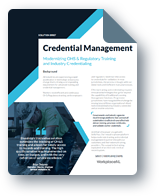







When people talk about digital transformation, they often speak as though it’s something you eventually finish.
After working with provincial workplace safety organizations across Canada over the past decade, I’ve come to believe the opposite.
The organizations seeing the greatest long-term success aren’t the ones that completed digital transformation—they’re the ones that never stopped improving.
For decades, Workers’ Compensation Boards and provincial workplace safety organizations have played a vital role in improving occupational health and safety across Canada. Through mandatory certifications, employer education, awareness programs, and industry-specific training, they’ve helped create safer workplaces, reduce injuries, and establish consistent standards that protect millions of Canadian workers.
That mission has never been more important.
But the way it’s delivered is evolving.
As workforce expectations change and governments continue advancing their digital service strategies, provincial training systems are entering a new stage of maturity. The conversation is no longer about simply offering online learning. It’s about creating digital infrastructure that continuously improves how regulated training is delivered, managed, monitored, and credentialed across an entire province.
Today’s workers expect digital experiences that are intuitive, accessible, and available when they need them.
Employers want greater visibility into workforce compliance. Regulators need stronger oversight, trusted credential management, and meaningful reporting. Training providers are looking for simpler administration and better insight into learner outcomes.
Meeting those expectations requires more than digitizing existing processes. It requires building systems that can continue improving as workforce needs, regulations, and technology evolve.
More than one million workplace injuries are reported in Canada each year, reinforcing the ongoing importance of accessible, consistent, and effective workplace safety education.
As safety systems continue to evolve, the digital infrastructure supporting workforce training, compliance, and credential management has to evolve with them.
Sources: Government of Canada Labour Program; International Labour Organization
Think about how people renew a passport, file their taxes, or access online banking today. They expect services to be secure, intuitive, and available whenever they need them.
Mandatory workplace training is no different.
Workers increasingly expect to complete required training online and on their own schedule.
Employers expect faster onboarding, instant credential verification, and better compliance visibility.
Training providers want fewer administrative tasks and more meaningful learner insights.
Regulators need consistent program delivery, stronger oversight, and real-time reporting.
Collectively, those expectations are reshaping how provincial training systems need to operate.
Across Canada, many jurisdictions have already taken an important first step by expanding regulated workplace safety training beyond traditional classroom delivery and introducing flexible online learning options.
We’ve been fortunate to be part of that journey.
Working with organizations in Ontario, Newfoundland and Labrador, Saskatchewan, Manitoba, and beyond, we’ve helped modernize regulated training delivery through the SkillsPass™ Learning and Credential Management Platform and custom online learning solutions.
What’s been interesting is watching what happens next.
Time and again, I’ve seen organizations begin with a single online training initiative only to realize the real value wasn’t the course itself. It was everything surrounding it: stronger reporting, better learner experiences, improved compliance visibility, streamlined administration, and trusted digital credentials.
That’s when the conversation changes.
Instead of asking:
“How do we add another online course?”
Organizations begin asking a much more strategic question:
“How do we continuously improve the entire training and credential lifecycle?”
To me, that’s where digital transformation becomes something much more meaningful.
One of the biggest lessons I’ve learned is that digital transformation isn’t a project with a completion date.
The jurisdictions and WCB regulators that embraced digital training several years ago aren’t standing still. They’re improving learner experiences, expanding self-service capabilities, strengthening analytics, enhancing mobile accessibility, and advancing digital credential management.
The goal is no longer simply to digitize training.
It’s to continually improve the entire experience.
This isn’t just something we’re seeing in workplace safety.
Governments around the world are reaching the same conclusion.
Recent OECD research found that while many governments have established digital strategies and service standards, only 28% of OECD countries have standardized approaches for measuring the burden public services place on users. It’s a reminder that continuous improvement—not simply digitization—remains one of the biggest opportunities in public sector modernization.
The jurisdictions seeing the greatest long-term success aren’t treating modernization as a technology implementation.
They’re treating it as an ongoing strategy.
Once organizations begin thinking this way, the technology itself starts looking very different.
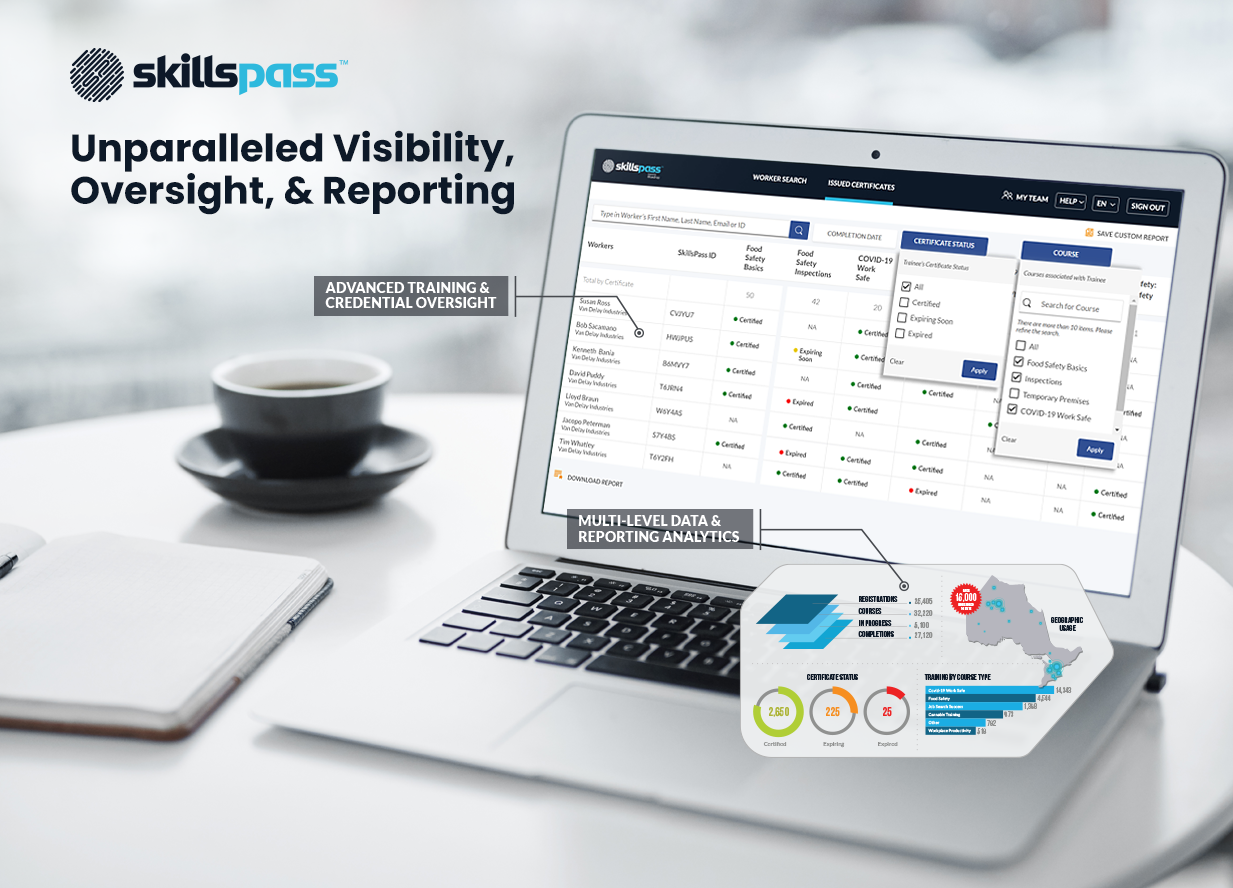
Modern workforce training platforms are no longer just learning management systems. They’re integrated environments that bring together learning, compliance, reporting, credentialing, and workforce intelligence into a single trusted system.
That can include:
Together, these capabilities improve transparency, reduce administrative effort, strengthen oversight, and create a better experience for learners, employers, providers, regulators, and government alike.
Training only creates value if people can easily prove they’ve completed it.
Paper certificates, emailed PDFs, and disconnected records create unnecessary friction for employers, learners, training providers, and regulators alike.
Digital credentials change that.
Secure, verifiable credentials stay with workers throughout their careers, making onboarding faster, compliance easier, and credential verification almost instantaneous.
✔ Instantly verifiable
✔ Portable between employers
✔ Reduce administrative burden
✔ Simplify compliance audits
✔ Support workforce mobility
✔ Create trusted lifelong learning records
This will only become more important as labour mobility continues to increase across Canada.
Governments are actively working to reduce barriers between provinces, making secure credential verification and trusted workforce records increasingly important.
Around the world, governments increasingly recognize that modern public services depend not only on digital services, but on secure, interoperable digital infrastructure.
The same is becoming true for regulated workforce training.
When I look at where provincial workplace safety training is headed, I don’t see another technology wave.
I see a shift in mindset.
Modernization isn’t about replacing proven safety programs.
It isn’t even about replacing existing technology.
It’s about continually improving both.
Across Canada, provincial workplace safety organizations have already demonstrated what’s possible by expanding learner access, improving operational efficiency, and strengthening regulatory oversight through digital transformation.
One area I’m particularly excited about is the role AI will play in this next phase of modernization. Not because AI replaces expertise or proven training programs, but because it has the potential to make digital platforms more intuitive, responsive, and helpful. Imagine learners receiving personalized training recommendations and a skill-development roadmap based on their role, organization, experience, or career goals- and this isn’t futuristic, we’re actually building this now as an embedded feature within our own SkillsPass platform. Imagine getting instant answers to program questions through intelligent assistants, reducing administrative effort through automation, or giving regulators and organizations deeper insights that help guide workforce development and compliance. Used thoughtfully, AI won’t replace regulated training—it will make the entire ecosystem work better for everyone involved.
The next phase is building platforms that become smarter every year by:
Because successful digital transformation isn’t measured by the day a platform launches.
It’s measured by how well that platform adapts to whatever comes next.
Key Takeaway
Modernization isn’t measured by when a platform launches. It’s measured by how easily that platform adapts to what’s next.
The organizations leading the next generation of workplace safety training won’t simply be asking whether they should digitize another process.
They’ll be asking how every improvement makes life easier for workers, employers, instructors, providers, regulators, and government.
Technology simply becomes the platform that enables that progress.
At Bluedrop ISM, we’re proud to partner with provincial governments, Workers’ Compensation Boards, regulators, industry associations, and oversight agencies across Canada as they continue that journey.
Through the SkillsPass™ Learning and Credential Management Platform, we’re helping millions of learners and thousands of organizations securely deliver workforce training, manage credentials, strengthen compliance, and gain better visibility into workforce readiness.
More importantly, we’re helping build digital infrastructure that evolves alongside changing regulations, workforce expectations, and emerging technologies.
Because I don’t believe the future of workplace safety is simply digital.
I believe it’s connected.
It’s measurable.
And it’s built for continuous improvement.
Ready to explore what’s next?
Visit our website to learn more, or schedule a conversation about how SkillsPass™ helps governments, regulators, Workers’ Compensation Boards, and industry organizations build connected training ecosystems that continuously improve workforce readiness, compliance, and credential management.

Simply complete the form below and a Bluedrop ISM team member will contact you to arrange your 30 minute power demo of the SkillsPass training platform and our related workforce training solutions.
Free Trial!
Simply complete the form below. A SkillsPass team member will contact you with the details for your 90-day free, no-obligation trial of SkillsPass- including setup, activation, feature walk-through, and the various terms and conditions that apply.
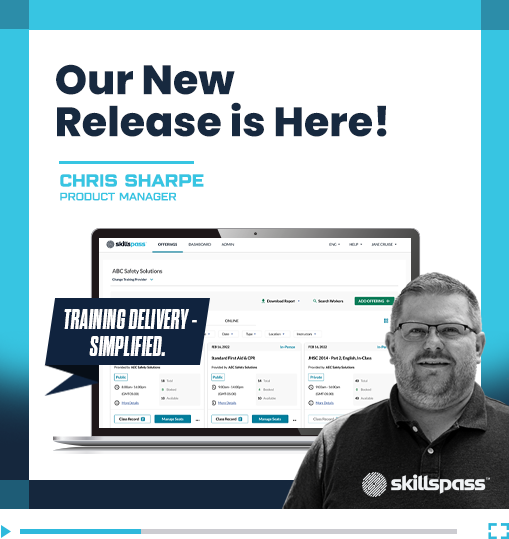
Bluedrop’s experience and proven eLearning content development capabilities are foundational in supporting our customers’ upskilling & reskilling requirements, and in maximizing the power of the SkillsPass™ Integrated Skills Management Platform.

Whether for broad State/Province upskilling programs, or single use, rapid response training requirements for a specific industry requirement- we can deliver an online solution with proven effectiveness and verifiable training results.
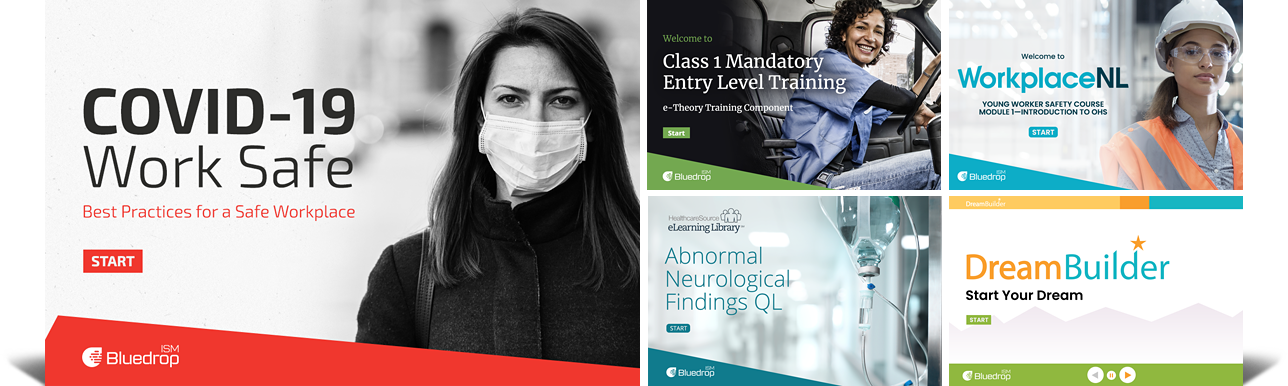

Bluedrop has developed and deployed eLearning training to support large and diverse upskilling and reskilling initiatives of governments and industries around the globe.

Bluedrop has amassed a a vast library of proven and impactful eLearning courses. Specialization includes commercial truck driver training, workplace productivity, entrepreneurship and a host of regulatory inspired courses,

The eLearning content solution combined with our SkillsPass ISM platform to help connect workers, employers, and related stakeholders. We also offer full execution support and program management including marketing, adoption, and customer support specialists that help drive successful uptake and results.

Offers online training, certification, and credential management capabilities to support the transformation of broad-based upskilling/reskilling.

Is industry-agnostic, and is now securely deployed with governments, industry associations and employers around the world, with close to 3 Million users.

Enables the deployment of wide ranging course content options to support skill development including industry mandated, OH&S, and upskilling in those critical in-demand functions required in the new digital economy.

Provides partners with a digital, single line-of-sight into training results, credentials, and certifications at the industry through to the individual level.
SAFEGUARD
With security and support that safeguards our client investments in two key ways:
DELIVER
Providing end-to-end training delivery and credential management for all training formats…
REIMAGINE
A seamless online training ecosystem connection for all stakeholders or partners…
Giving Bank:
Eligibility Requirements (None)
Connect with us and send us your information – we’re happy to learn more and explore whether we are a fit.
Community Events:
Eligibility Requirements (None)
Connect with us and send us your information – we’re happy to learn more and explore whether we are a fit.
Supporting Refugees and Recent Immigrants :
Eligibility Requirements
Applications can be received from the following:
Applications can be received from the following:
Eligibility Requirements