





Canada has made meaningful progress on labour mobility. Agreements have been signed, standards have been aligned, and federal attention has increased—including recent momentum through initiatives like the One Canadian Economy Act, which aims to reduce interprovincial barriers and improve workforce mobility across the country.
And yet, on the ground, workers still face delays moving between provinces, employers, and regulated environments.
Why?
Because the challenge has shifted.
For years, labour mobility was framed as a policy issue—different rules, different standards, different requirements. But today, that’s only part of the story.
The bigger constraint is now how those rules are executed across fragmented systems. Even when credentials are recognized, the process of validating, interpreting, and approving them remains manual, inconsistent, and slow.
Modern workforces are more mobile than ever. Workers move between employers, across regions, and between industries. But the systems supporting them haven’t kept pace.
As we highlighted in our previous blog, traditional learning management systems were never designed for this level of mobility. They were built for single employers, static roles, and limited external validation. That model no longer reflects reality.
Federal leadership plays an important role in setting direction, but labour mobility is ultimately operationalized at the provincial and regulatory level. Regulators interpret requirements, systems process applications, and decisions happen locally.
Without coordination across these layers, mandates alone cannot deliver real mobility. They define intent, but they don’t enable execution. Many regulators still rely on legacy IT systems that cannot easily support modern credential verification pipelines.
True labour mobility requires more than aligned policy—it requires connected systems and coordinated processes.
Today, many regulators operate with different levels of digital maturity, legacy infrastructure, and limited interoperability. This creates a “translation gap” between jurisdictions, where applications slow down even when they should move quickly.
Solving this doesn’t necessarily require replacing existing systems—it requires connecting them.
Modern infrastructure can enable real-time credential verification at source, pre-validated and complete applications, automated error detection before submission, and seamless data flow between jurisdictions. In this way, technology can bridge the gap without changing policy or replacing regulator systems.
When coordination improves, outcomes change quickly. Application processing times shrink dramatically, workers submit complete and verified information upfront, regulators spend less time on administrative review, and employers gain faster access to qualified workers.
Applications that once took weeks can move in days—or even hours—when supported by streamlined, connected processing.
Having said that, it’s important to note that any purpose-built solution must respect a core reality: regulators must retain control. They define standards, make decisions, and ensure public safety.
Canada has already done much of the hard work. Policy alignment has advanced, standards are converging, and the intent is clear.
But operationalizing this at scale requires more than coordination in principle—it requires infrastructure that regulators can adopt and use quickly and confidently.
In practice, that means enabling systems that can integrate without disruption, processes that reduce administrative burden rather than add to it, and tools that fit within existing regulatory environments rather than replace them.
Increasingly, this is being achieved through purpose-built digital credentialing and application platforms designed specifically for regulated industries and inter-jurisdictional workflows. These approaches allow regulators to plug into shared infrastructure without overhauling legacy systems, leverage standardized and pre-validated application flows, and improve service levels without compromising autonomy—all while maintaining full control over decision-making.
Workforce training innovators, like Bluedrop, that work closely with regulators and industry partners are demonstrating how this approach can be applied in practice. By leveraging existing scalable solutions and supporting diverse regulatory requirements, they are enabling mobility outcomes without forcing system-wide change, focusing instead on simplifying how workers, credentials, and regulatory processes connect across jurisdictions.
The next phase of labour mobility in Canada won’t be defined by new agreements. It will be defined by how effectively we operationalize the ones we already have.
Unlocking Canada’s workforce will depend on our ability to bridge the gap between policy, systems, and real-world outcomes.
For organizations and regulators looking to move from intent to execution, emerging platforms are already demonstrating how integrated training delivery and digital credential management can support top-down, cross-jurisdictional labour mobility—connecting workers, employers, and regulators through shared, trusted infrastructure.
To learn more about how this approach is being applied in practice, and how we’re helping enable seamless, interoperable mobility across regulated industries, visit Bluedrop ISM.

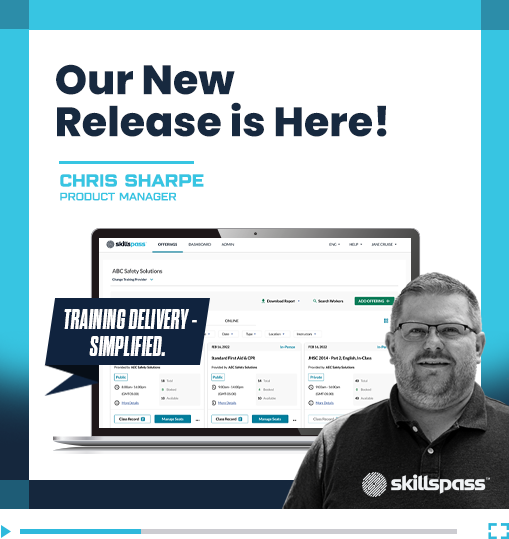
Simply complete the form below and a Bluedrop ISM team member will contact you to arrange your 30 minute power demo of the SkillsPass training platform and our related workforce training solutions.
Free Trial!
Simply complete the form below. A SkillsPass team member will contact you with the details for your 90-day free, no-obligation trial of SkillsPass- including setup, activation, feature walk-through, and the various terms and conditions that apply.
Bluedrop’s experience and proven eLearning content development capabilities are foundational in supporting our customers’ upskilling & reskilling requirements, and in maximizing the power of the SkillsPass™ Integrated Skills Management Platform.

Whether for broad State/Province upskilling programs, or single use, rapid response training requirements for a specific industry requirement- we can deliver an online solution with proven effectiveness and verifiable training results.


Bluedrop has developed and deployed eLearning training to support large and diverse upskilling and reskilling initiatives of governments and industries around the globe.

Bluedrop has amassed a a vast library of proven and impactful eLearning courses. Specialization includes commercial truck driver training, workplace productivity, entrepreneurship and a host of regulatory inspired courses,

The eLearning content solution combined with our SkillsPass ISM platform to help connect workers, employers, and related stakeholders. We also offer full execution support and program management including marketing, adoption, and customer support specialists that help drive successful uptake and results.

Offers online training, certification, and credential management capabilities to support the transformation of broad-based upskilling/reskilling.

Is industry-agnostic, and is now securely deployed with governments, industry associations and employers around the world, with close to 3 Million users.

Enables the deployment of wide ranging course content options to support skill development including industry mandated, OH&S, and upskilling in those critical in-demand functions required in the new digital economy.

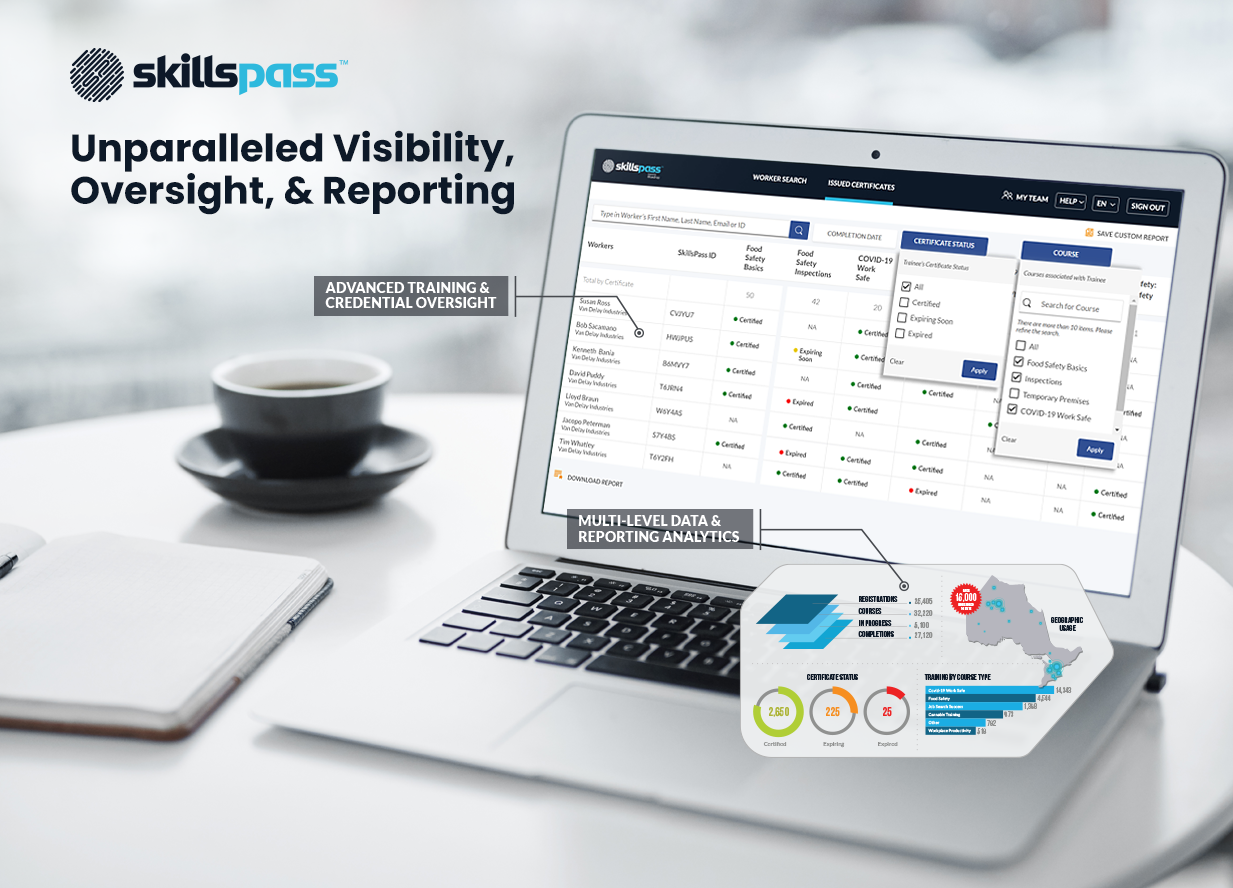
Provides partners with a digital, single line-of-sight into training results, credentials, and certifications at the industry through to the individual level.
SAFEGUARD
With security and support that safeguards our client investments in two key ways:
DELIVER
Providing end-to-end training delivery and credential management for all training formats…
REIMAGINE
A seamless online training ecosystem connection for all stakeholders or partners…
Giving Bank:
Eligibility Requirements (None)
Connect with us and send us your information – we’re happy to learn more and explore whether we are a fit.
Community Events:
Eligibility Requirements (None)
Connect with us and send us your information – we’re happy to learn more and explore whether we are a fit.
Supporting Refugees and Recent Immigrants :
Eligibility Requirements
Applications can be received from the following:
Applications can be received from the following:
Eligibility Requirements