






How the evolution of mandatory entry-level training and online learning is creating new opportunities for Canada’s transportation industry.
Canada’s commercial trucking industry is changing—and so is the way its drivers are trained.
Across the country, governments, regulators and industry stakeholders are working toward more consistent entry-level training requirements, while exploring new approaches to make training more accessible, flexible and efficient.
It’s a topic we’ve been following closely at Bluedrop ISM, and one that continues to generate valuable conversations with transportation leaders, regulators and training providers.
At recent industry events, including the Professional Truck Training Alliance of Canada (PTTAC) Annual Conference and the Private Motor Truck Council of Canada (PMTC) Western Conference, we’ve welcomed opportunities to connect with industry colleagues and exchange perspectives on the challenges and opportunities facing commercial transportation.
These conversations reinforce the importance of continuing to evolve how we prepare the next generation of professional drivers.
At the centre of that evolution are two complementary developments: the movement toward greater alignment with national training standards, and the growing role of technology-enabled learning in delivering foundational driver education.
Together, they offer an opportunity to modernize commercial driver training while maintaining the practical skills and safety standards the industry depends on.
Commercial trucking remains essential to Canada’s economy, connecting businesses, communities and supply chains from coast to coast.
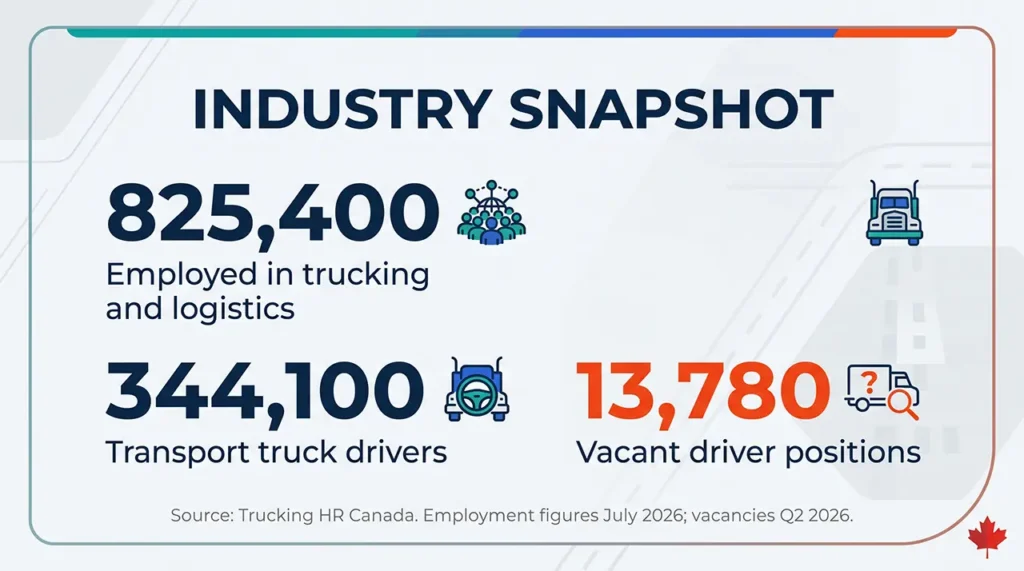
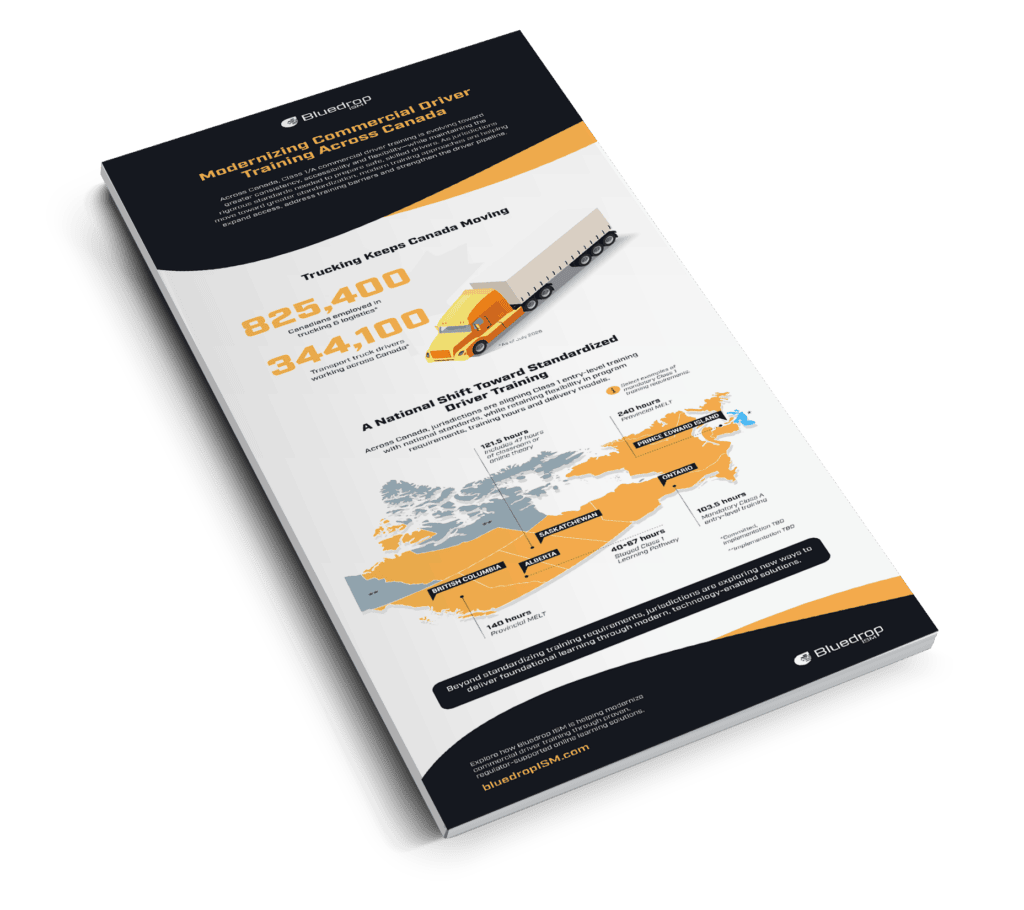
According to Trucking HR Canada, Canada’s trucking and logistics sector employed approximately 825,400 people in July 2026, including 344,100 transport truck drivers.
Despite employment growth, workforce pressures persist. Labour market data identified 13,780 vacant transport truck driver positions in the second quarter of 2026, underscoring the continuing need to attract, train and retain qualified drivers.
While recruitment and retention are essential parts of the equation, we believe training accessibility deserves equal attention.
For someone considering a career in commercial driving, the availability, location, cost and scheduling of training can all influence their ability to enter the profession.
Modernizing how training is delivered offers an opportunity to reduce some of these barriers while maintaining the high standards expected of professional drivers.
For many years, commercial driver training requirements varied significantly across Canada, creating differences in curriculum, required training hours and approaches to delivery.
The introduction of National Safety Code (NSC) Standard 16, which establishes a national framework for Class 1 entry-level driver training, has helped advance a more consistent foundation for preparing new commercial drivers.
The standard emphasizes essential knowledge and practical competencies, supporting a common approach to driver readiness and road safety.
Today, jurisdictions across Canada have implemented mandatory entry-level training frameworks aligned with national training objectives, although provincial requirements continue to differ.
For example:
These differences reflect regional priorities and regulatory approaches, while demonstrating how a common national framework can accommodate provincial flexibility.
And that’s an important distinction. In our view, the objective isn’t necessarily to make every provincial program identical. It’s to establish greater consistency in the foundational knowledge and competencies expected of professional commercial drivers, while allowing jurisdictions to respond to their own needs.
While national standards help establish what new drivers need to learn, advances in learning technology are creating opportunities to rethink how foundational knowledge is delivered.
Traditionally, much of the theory component of commercial driver training has relied on scheduled, instructor-led classroom sessions. These remain valuable, particularly where learners benefit from direct interaction and additional instructional support.
However, technology-enabled approaches—including self-paced online courses, virtual classrooms and digital assessments—can provide additional options for delivering consistent, structured learning.
We’ve seen firsthand how these approaches can help address challenges associated with geography, scheduling and training capacity, particularly in a country as geographically diverse as Canada.
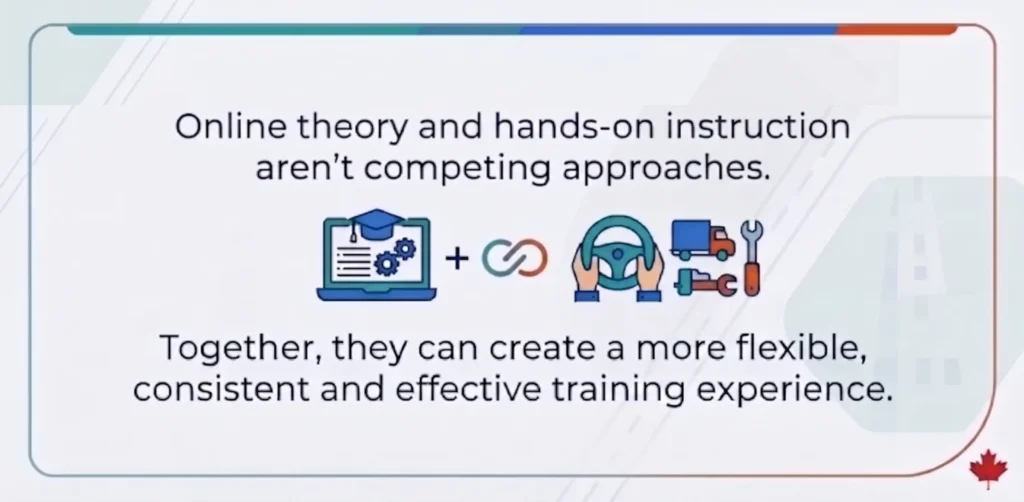
Importantly, these approaches are designed to support, not replace, essential in-yard and behind-the-wheel training.
Driving a commercial vehicle requires practical instruction, demonstrated competence and supervised experience that cannot be replicated through online theory alone.
The opportunity lies in combining the strengths of both approaches.
Canada already has practical examples of technology-enabled Class 1 training, and shameless plug alert, we’ve been fortunate enough to play a role in this evolution.
In 2021, Saskatchewan introduced a regulator-supported online MELT theory option, with Bluedrop ISM helping develop and deliver the solution.
Today, Saskatchewan Government Insurance recognizes 47 hours of classroom or online instruction as part of its 121.5-hour mandatory training requirement, alongside 17.5 hours of in-yard training and 57 hours behind the wheel.
Alberta has also taken steps to modernize its training approach.
In April 2025, the province replaced its traditional MELT program with a staged Class 1 Learning Pathway, incorporating a 40-hour Entry Program that can be completed through online learning.
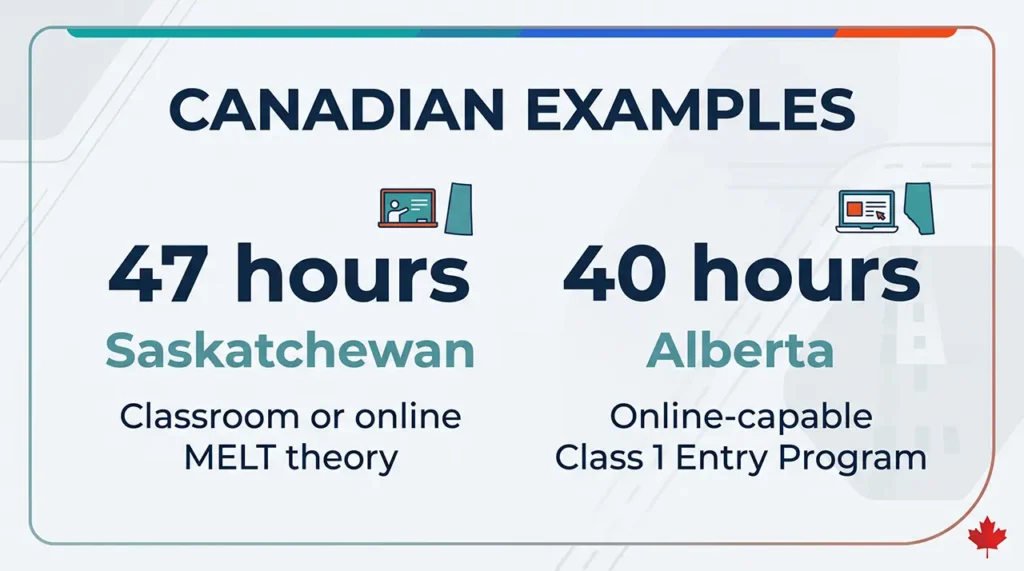
This is followed by a Core Learning Program focused on practical in-yard and in-cab instruction. As of September 2026, the Core Learning component includes 67 hours of training.
Bluedrop ISM has supported Alberta’s technology-enabled approach through an adapted version of its Canadian-developed online commercial driver training.
We’re pleased to have contributed to these initiatives, particularly because they demonstrate how training innovation can be implemented within established regulatory frameworks.
Although the Saskatchewan and Alberta models differ, both demonstrate how digital theory delivery can operate alongside rigorous practical training. Other jurisdictions are now exploring similar opportunities for MELT online augmentation, with some already leveraging online training for ancillary driver training and subsets (e.g., Ontario’s online Air Brakes refresher program).
And as more jurisdictions consider the opportunities associated with modernized delivery, these early implementations can offer useful lessons for the broader industry.
The value of modern training delivery extends beyond learner convenience.
Of course, technology alone isn’t the answer. Effective implementation still requires sound instructional design, accessible technology, meaningful assessment, appropriate learner support and regulatory oversight.
We believe the greatest value comes from taking a balanced approach—leveraging technology where it adds efficiency and accessibility, while preserving the practical instruction and demonstrated competence essential to road safety.
As Canada’s transportation industry continues to evolve, modernizing entry-level driver training offers an opportunity to address longstanding challenges while maintaining a clear focus on safety and professional competence.
Greater national alignment provides a common foundation. Technology-enabled learning offers new possibilities for accessibility, consistency and efficiency. Essential hands-on instruction ensures aspiring drivers can translate knowledge into practical skills.
Together, these developments can help create more effective training pathways and support the industry’s ongoing efforts to attract and prepare the next generation of commercial drivers.
At Bluedrop ISM, we’re encouraged by the progress already underway and by the continued dialogue among regulators, training providers and industry associations across Canada.
We look forward to being part of those conversations and helping advance approaches that make commercial driver training more accessible, consistent and effective.
Explore the infographic: Modernizing Commercial Driver Training Across Canada
Learn more: Bluedrop ISM — Transportation Training Solutions

Simply complete the form below and a Bluedrop ISM team member will contact you to arrange your 30 minute power demo of the SkillsPass training platform and our related workforce training solutions.
Free Trial!
Simply complete the form below. A SkillsPass team member will contact you with the details for your 90-day free, no-obligation trial of SkillsPass- including setup, activation, feature walk-through, and the various terms and conditions that apply.
Bluedrop’s experience and proven eLearning content development capabilities are foundational in supporting our customers’ upskilling & reskilling requirements, and in maximizing the power of the SkillsPass™ Integrated Skills Management Platform.

Whether for broad State/Province upskilling programs, or single use, rapid response training requirements for a specific industry requirement- we can deliver an online solution with proven effectiveness and verifiable training results.


Bluedrop has developed and deployed eLearning training to support large and diverse upskilling and reskilling initiatives of governments and industries around the globe.

Bluedrop has amassed a a vast library of proven and impactful eLearning courses. Specialization includes commercial truck driver training, workplace productivity, entrepreneurship and a host of regulatory inspired courses,

The eLearning content solution combined with our SkillsPass ISM platform to help connect workers, employers, and related stakeholders. We also offer full execution support and program management including marketing, adoption, and customer support specialists that help drive successful uptake and results.

Offers online training, certification, and credential management capabilities to support the transformation of broad-based upskilling/reskilling.

Is industry-agnostic, and is now securely deployed with governments, industry associations and employers around the world, with close to 3 Million users.

Enables the deployment of wide ranging course content options to support skill development including industry mandated, OH&S, and upskilling in those critical in-demand functions required in the new digital economy.

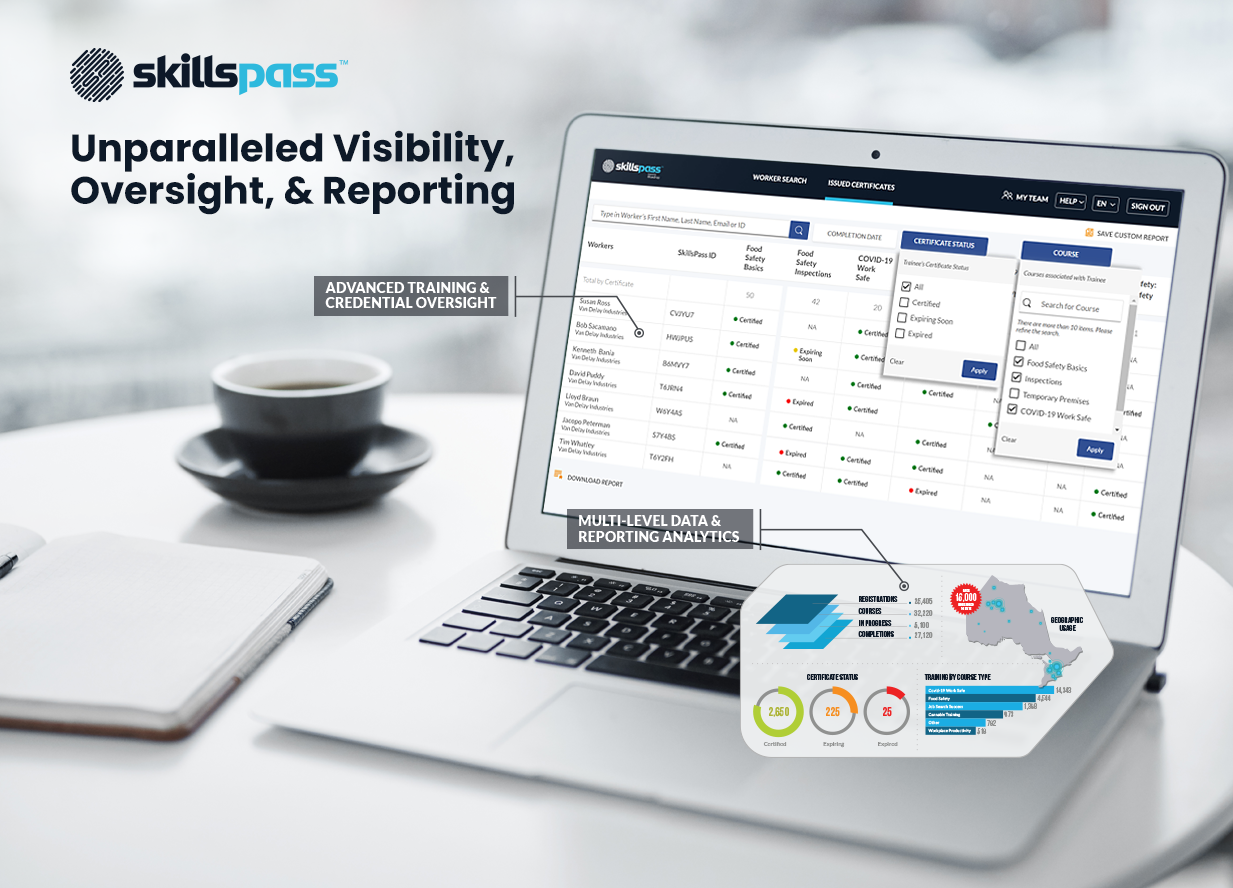
Provides partners with a digital, single line-of-sight into training results, credentials, and certifications at the industry through to the individual level.
SAFEGUARD
With security and support that safeguards our client investments in two key ways:
DELIVER
Providing end-to-end training delivery and credential management for all training formats…
REIMAGINE
A seamless online training ecosystem connection for all stakeholders or partners…
Giving Bank:
Eligibility Requirements (None)
Connect with us and send us your information – we’re happy to learn more and explore whether we are a fit.
Community Events:
Eligibility Requirements (None)
Connect with us and send us your information – we’re happy to learn more and explore whether we are a fit.
Supporting Refugees and Recent Immigrants :
Eligibility Requirements
Applications can be received from the following:
Applications can be received from the following:
Eligibility Requirements
