





When we published our previous article, From Recruitment to Retention, the conversation centered on a simple but important shift: recruiting healthcare professionals is only the beginning. Long-term workforce success depends on how effectively organizations onboard, support, and retain the people they bring into the system.
Since then, conversations with healthcare leaders across Canada have continued to evolve.
The discussion is no longer just about attracting talent.
It’s about preparing that talent to succeed—quickly, confidently, and consistently.
As healthcare systems continue to welcome internationally educated nurses (IENs), new graduates, and returning clinicians, many organizations are asking a different question:
Every healthcare organization provides orientation.
Policies are reviewed.Systems are introduced. Mandatory education is completed. Workstations are assigned. Schedules are created.
Orientation is essential—but orientation alone doesn’t prepare someone for the realities of delivering patient care in today’s increasingly complex clinical environments.
Clinical readiness is something different. It is the confidence to prioritize competing demands.
Those capabilities develop through structured practice, coaching, reflection, and experience—not simply by attending orientation sessions.
As healthcare environments become more complex, organizations are recognizing that readiness deserves its own strategy.
One of the greatest challenges in healthcare onboarding isn’t a lack of effort.
It’s inconsistency.
Across large healthcare organizations, onboarding often varies between units, facilities, departments, and even individual preceptors.
Some clinicians receive extensive coaching. Others receive only what time allows. Some encounter high-acuity situations early. Others don’t.
Every preceptor brings valuable experience—but every preceptor also teaches a little differently.
That variability can lead to differences in confidence, preparedness, and time to independent practice.
The result isn’t simply an inconsistent learner experience.
It creates operational variability across the organization itself.
For healthcare leaders focused on quality, patient safety, and workforce sustainability, reducing unnecessary variation has become just as important as expanding recruitment.
Canada continues to invest heavily in growing the healthcare workforce.
The World Health Organization estimates the global shortage of healthcare workers could reach 10 million by 2030, while health systems across Canada continue expanding pathways for internationally educated professionals and accelerating recruitment initiatives.
But adding new staff creates another challenge.
Who has the capacity to prepare them?
Experienced nurses and clinical educators are already balancing patient care, mentoring responsibilities, staffing shortages, and increasingly complex workloads.
Every hour spent repeating foundational onboarding content is an hour unavailable for direct patient care or advanced coaching.
That doesn’t mean mentorship is less important.
It means mentorship has become too valuable to spend on information that could be delivered more consistently through modern learning approaches.
Healthcare organizations aren’t looking to replace preceptors.
They’re looking to maximize the impact of the expertise only preceptors can provide.
Traditional onboarding relies heavily on learning through experience.
But experience can be unpredictable.
A new nurse might encounter a deteriorating patient during their first shift—or not for several weeks.
They may experience difficult conversations with families early—or much later.
Some critical situations occur frequently.
Others are rare but high risk.
Simulation changes that equation.
Instead of waiting for important clinical situations to occur naturally, organizations can intentionally expose learners to realistic scenarios in a safe, supported environment.
Through repeated practice, structured debriefing, and guided reflection, clinicians develop confidence before facing those situations with real patients.
Increasingly, organizations are combining immersive simulation, virtual reality, digital learning, and expert mentorship into integrated readiness pathways that strengthen clinical judgment while reducing variability in the onboarding experience.
Did You Know?
Research has shown that simulation-based education can improve clinical competence, confidence, communication, teamwork, and patient safety outcomes while allowing learners to safely practice high-risk, low-frequency scenarios before encountering them in clinical settings.
This shift is exactly why organizations are beginning to rethink how clinical onboarding is designed.
This also changes how onboarding success is measured—moving beyond attendance and completion toward confidence, clinical judgment, consistency, and time to independent practice.
Rather than relying solely on classroom sessions and unit-based orientation, many health systems are implementing structured readiness pathways that combine:
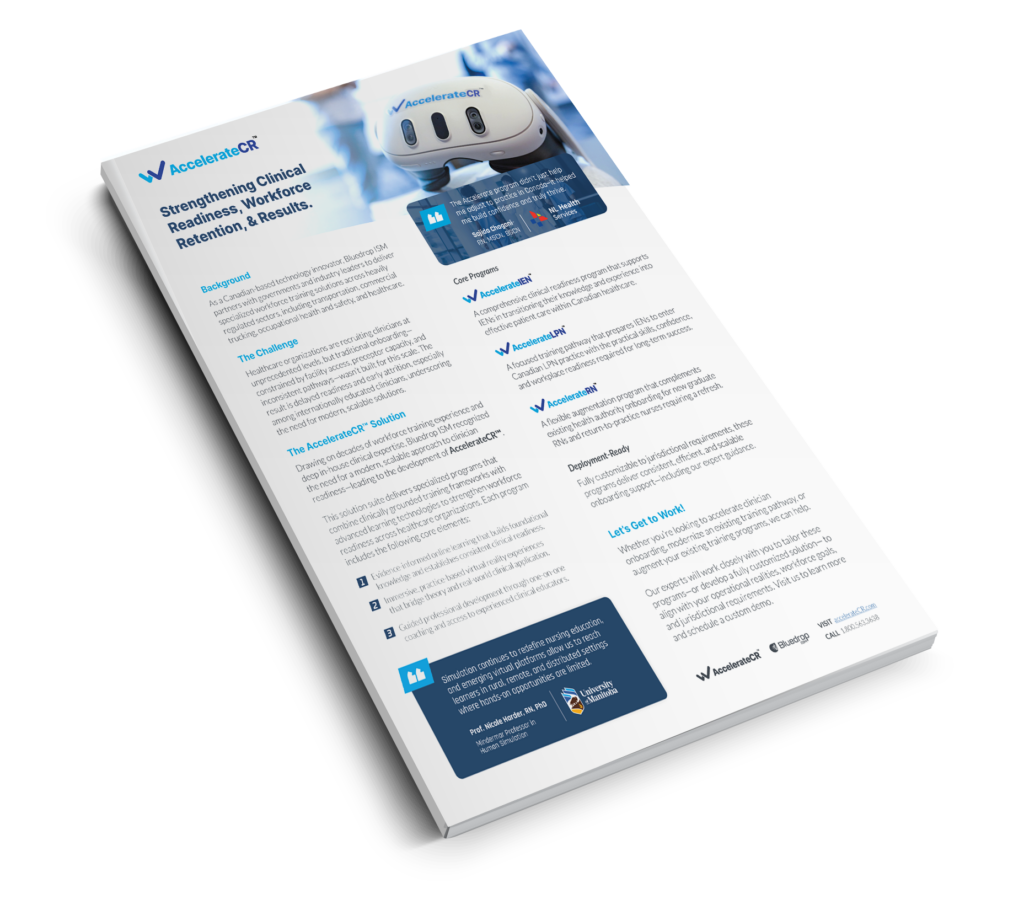
Programs like AccelerateIEN™, part of Bluedrop ISM’s AccelerateCR™ clinical readiness suite, were developed around this philosophy. By integrating Canadian nursing essentials, simulation-based learning, mentorship, and workplace support, the program helps healthcare organizations create more standardized, scalable pathways that accelerate readiness while supporting both learners and preceptors.
Early results from the Newfoundland and Labrador pilot have been encouraging. Participating internationally educated nurses are reaching independent practice faster, while the program is also reducing demands on preceptors and is thereby reducing administrative costs and burden.
Importantly, these programs don’t aim to replace organizational orientation.They strengthen it.
Healthcare workforce challenges won’t be solved through recruitment alone.
Nor will they be solved by asking increasingly stretched clinical teams to do more with less.
The organizations making the greatest progress are recognizing that workforce readiness is a strategic capability.
One that can be designed.
Measured.
Standardized.
And continuously improved.
Because ultimately, the goal isn’t simply to welcome new clinicians into the organization.
It’s to help every clinician reach confident, independent practice sooner—supporting better experiences for staff, stronger workforce resilience, and safer patient care.
As healthcare continues to evolve, orientation will always have a place.
But increasingly, it is clinical readiness that will define how successfully healthcare organizations build the workforce of tomorrow.
Healthcare has invested enormous effort into expanding recruitment and creating new pathways into practice.
The next opportunity lies in ensuring those investments translate into confident, capable clinicians who are prepared to succeed from the moment they begin caring for patients.
Organizations that treat clinical readiness as a strategic workforce priority—not simply an onboarding activity—will be better positioned to improve consistency, strengthen retention, support their clinical teams, and ultimately deliver better patient care.
At Bluedrop ISM, we’re proud to be working alongside healthcare organizations and innovation partners across Canada to help modernize clinical readiness through scalable, simulation-enhanced learning and workforce development solutions that complement and strengthen existing onboarding programs.
To learn more about how healthcare organizations are transforming orientation into measurable clinical readiness, explore our AccelerateCR™ suite of solutions. Then join us for our upcoming executive webinar, hosted in partnership with Lumeto, where we’ll discuss the future of clinical readiness, share lessons learned from real-world implementations, and provide a live demonstration of how simulation-enhanced learning is helping healthcare organizations prepare practice-ready clinicians faster, more consistently, and with greater confidence.

Simply complete the form below and a Bluedrop ISM team member will contact you to arrange your 30 minute power demo of the SkillsPass training platform and our related workforce training solutions.
Free Trial!
Simply complete the form below. A SkillsPass team member will contact you with the details for your 90-day free, no-obligation trial of SkillsPass- including setup, activation, feature walk-through, and the various terms and conditions that apply.
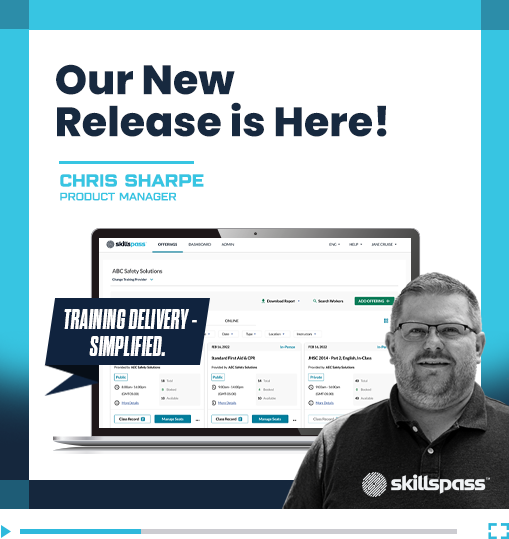
Bluedrop’s experience and proven eLearning content development capabilities are foundational in supporting our customers’ upskilling & reskilling requirements, and in maximizing the power of the SkillsPass™ Integrated Skills Management Platform.

Whether for broad State/Province upskilling programs, or single use, rapid response training requirements for a specific industry requirement- we can deliver an online solution with proven effectiveness and verifiable training results.
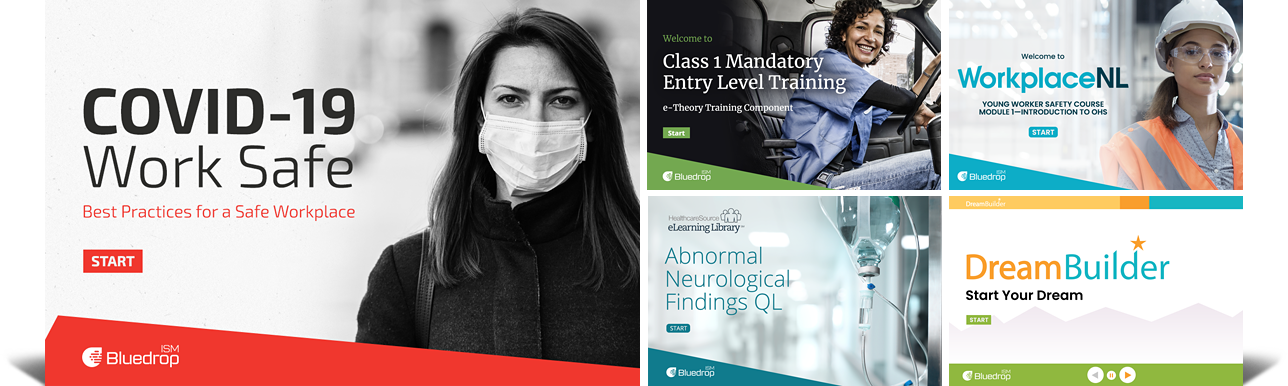

Bluedrop has developed and deployed eLearning training to support large and diverse upskilling and reskilling initiatives of governments and industries around the globe.

Bluedrop has amassed a a vast library of proven and impactful eLearning courses. Specialization includes commercial truck driver training, workplace productivity, entrepreneurship and a host of regulatory inspired courses,

The eLearning content solution combined with our SkillsPass ISM platform to help connect workers, employers, and related stakeholders. We also offer full execution support and program management including marketing, adoption, and customer support specialists that help drive successful uptake and results.

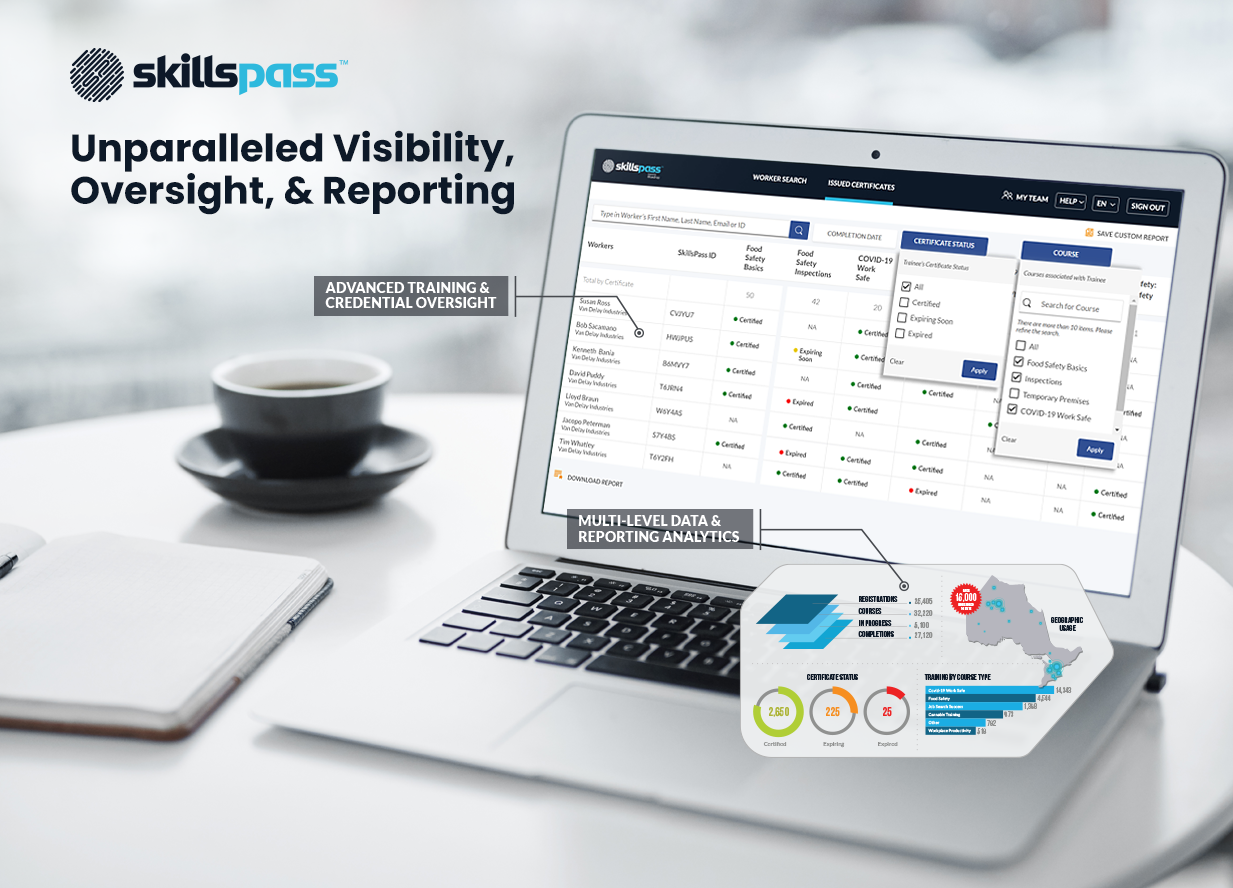
Offers online training, certification, and credential management capabilities to support the transformation of broad-based upskilling/reskilling.

Is industry-agnostic, and is now securely deployed with governments, industry associations and employers around the world, with close to 3 Million users.

Enables the deployment of wide ranging course content options to support skill development including industry mandated, OH&S, and upskilling in those critical in-demand functions required in the new digital economy.

Provides partners with a digital, single line-of-sight into training results, credentials, and certifications at the industry through to the individual level.
SAFEGUARD
With security and support that safeguards our client investments in two key ways:
DELIVER
Providing end-to-end training delivery and credential management for all training formats…
REIMAGINE
A seamless online training ecosystem connection for all stakeholders or partners…
Giving Bank:
Eligibility Requirements (None)
Connect with us and send us your information – we’re happy to learn more and explore whether we are a fit.
Community Events:
Eligibility Requirements (None)
Connect with us and send us your information – we’re happy to learn more and explore whether we are a fit.
Supporting Refugees and Recent Immigrants :
Eligibility Requirements
Applications can be received from the following:
Applications can be received from the following:
Eligibility Requirements